Monday, June 29, 2020

Garden of the Lion - with Process Shots!

Garden of the Lion, 18 x 18, oil on canvas, L. Daniel © 2020
SOLD

Revisiting this handsome lion with bigger brushes and larger canvas was so much fun. I love this guardian of the flowers. This one is fresh off the easel and available now at the Anderson Fine Art Gallery in St. Simons Island, Georgia! 

Here are process shots to show how it came together...

BLOCK IN - SKETCH
I began with an underdrawing (ultramarine and burnt siena). This allows me to check placement and scale of all the elements, and its a good place to make adjustments to the basic design before I get too far along.

BLOCK IN - VALUES
I established a "roadmap" for my values by indicating the shadow areas of the scene. Putting my darks in early and accurately gives me a structure to build on. I also stained the canvas with spots of alizarin crimson as place holders for my geraniums that would be painted last. 


STARTING WITH THE DARKS
Working dark to light allowed me to hold on to values. It is also the best way to build a painting... so much easier to add lighter colors on top of a strong base.  

ADDING THE LIGHTS
The key to keeping clean color is to use a light touch with subsequent layers. With alla prima painting, it can be tricky and "scrubbing" turns everything to mud. Beware.

Final Marks and Highlights
Once all value areas were established, I was able to suggest detail with final marks and highlights using slight value shifts. So important to save these until the very end, when everything else is working. I also painted the geraniums last to keep their marks clean and fresh. 

___________________________________

(I'm honored to be teaching in the Pre-Event Beginner's workshop! Please look for me there!)


Thursday, June 25, 2020

Backyard Rest Stop - Fix It Friday #17

Backyard Rest Stop, 16 x 12, oil on panel, L. Daniel © 2020

Todays makeover is one from the archives, and it's a good lesson in composition (on what NOT to do). I was drawn to this cozy scene in my backyard for it's familiarity, good vibes, and simple one-point perspective. I also wanted some practice observing perspective and architecture, so I gave it a go. (It was also raining and this was the only place to paint, and stay dry.)

BEFORE

AFTER

CHANGES:
Problem 1 - All the perspective lines led the viewer's eye right past my subject.
Fix - Added a railing to contain the eye within the porch area.
Fix - Made the coffee table edges curvy, to slow down the "racetrack" effect.
Fix - Lushed up my subject (added more flowers, warmed up color, added more suggested detail.)

Problem 2 - Overall tone was drab and flat.
Fix - Popped some warm light onto bricks.
Fix - Warmed up white window frames and siding.

OBSERVATIONS:
Lines of perspective can have a very strong directional impact. They can be like pointing arrows. In this case, my goal was to create a scene that the viewer would sit down in, and want to stay for awhile. Wouldn't it have been great if all the lines were pointing to my sitting area?? That wasn't happening. 

We want to use built-in lines of perspective (and other elements) to take the viewer TO our focal point... NOT away from it. What I learned from this one is to pay attention to where the "lines" are pointing, and be intentional about how I use them. 
___________________________________

(I'm honored to be teaching in the Pre-Event Beginner's workshop! Look for me there!)


Monday, June 22, 2020

Crane Courtyard and PleinAir Live!

Crane Courtyard, 18 x 18, oil on canvas, L. Daniel © 2020
SOLD

This larger work is fashioned after a smaller plein air piece I shared a few weeks ago. Crane's Cottage, at the Jekyll Island Club Hotel in Georgia, is the site of many weddings and special events. This intimate courtyard where lunch is sometimes served, offers a spot to get away, and have a "moment". I enjoyed my moment there immensely and found myself going back to the little scene, wanting to linger at this spot a bit longer. Painting it larger was just the ticket. 

It is newly available at the Anderson Fine Art Gallery in St. Simons Island, Georgia!!

And now for some BIG, BIG NEWS...
I am thrilled to be participating as an instructor in the upcoming PleinAir Live event! I will be presenting in the Pre-Event One-day Beginners Workshop, offering "the basics" to beginners who want to learn to paint outdoors. It will be a lot of fun, hope to see you there!

Click HERE for more info and to register!

Thursday, June 18, 2020

Leaning Tree - Fix It Friday #16

Leaning Tree, 9 x 12, oil on panel, L. Daniel © 2020

It was a hot, hot day on the Georgia coast. The light was drenching this tree, adding sparkle to its already dramatic pose. To paint it, I found the only shade around, but it was too close to the subject (no umbrella that day.) I could not see my whole subject without scanning it with my head. TOTAL mistake. I "thought" I could pull it off, and I knew better... but no. The brain can not put the parts together very easily (at least my brain can't).

If you have taken a class with me, you know how bossy I am about this. I pester my students to 1) be in the shade, and 2) be far enough away to see the subject with one glance. Why do I pester? Because I care... :)  

BEFORE

AFTER

CHANGES:
Problem 1 - The tree ended up looking dissected and flat.
Fix - Added the foreground side of tree canopy, giving it volume. 

Problem 2 - The tree looked emaciated.
Fix - Gave the tree its full summer foliage and added the drenching light. 

Problem 3 - Background tidal creek sat "on top" of the marsh as if at high tide. 
(Note: the tide came in as I was painting and that creek did appear... the problem was that I had already painted the rest of the scene at a lower tide level.)
Fix - Removed the distant tidal creek. 

OBSERVATIONS:
I struggled with not being able to "see" my subject. I struggled with not anticipating nature's changes. In fact, I did much better working from my memory on my fixes than I did from my obstructed view. Analyzing visual information is a very important part of direct painting. When that ability is blocked, it's a hard challenge to overcome. 

Huh! Just as with most things in life, it turns out we do better when we understand the "Big Picture". I'm keeping that in mind. 

________________________
Click Here to see Fix it Friday #12
Click Here to see Fix it Friday #13

Monday, June 15, 2020

Lion Planter (study)

Lion Planter (study), 8 x 8, oil on panel, L. Daniel
SOLD

This lion fountain at the Jekyll Island Club Hotel completely captured my imagination... They just don't make things with such care and detail any more! Here's what I found out about the meaning of lions in architecture... they depict nobility, power, valor, bravery and prosperity... well, no wonder they wanted this guy!!! Now the fountain is a planter full of beautifully delicate geraniums, and the lion is still there, keeping watch as his garden grows. 

This is a study for a larger painting finished this week... I loved the lion so much, I had to do him again! Sometimes that happens! ;)

Thursday, June 11, 2020

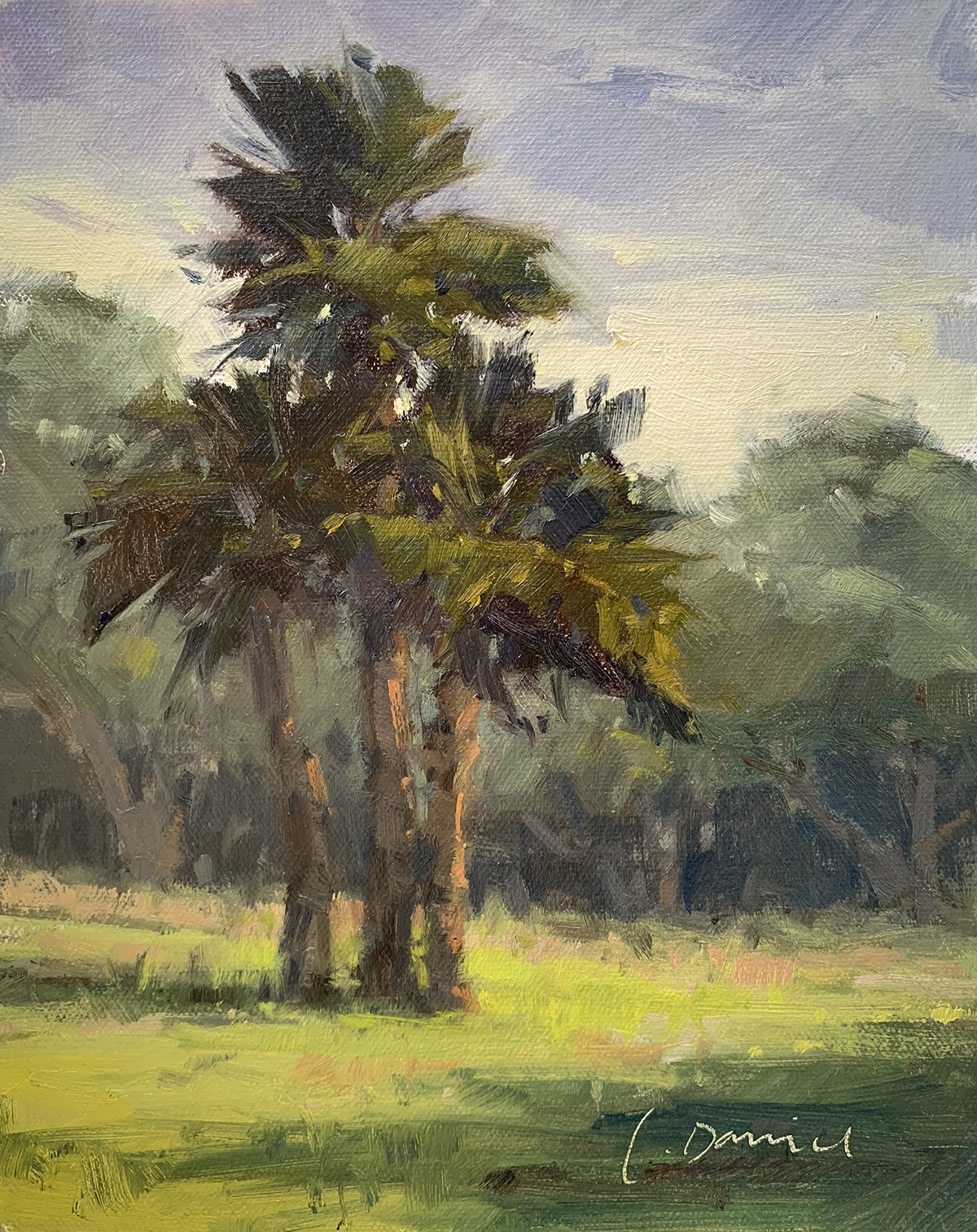
Palm Trio - Fix it Friday #15

Palm Trio, 10 x 8, oil on panel, L. Daniel © 2020

This grouping of trees was the subject of one of my class demos several years ago. It's on the beautiful grounds of Laguna Gloria (a place I have missed in this crazy spring.) There is always something that catches my eye, and on this particular morning it was the light on these three trees! But... well, see below...

BEFORE

AFTER

CHANGES:
Problem 1 - All three palm trees seemed to be growing out of the exact, SAME spot. 
Fix 1 - Separated the bases of the trees allowing each to be firmly grounded. 
Problem 2 - The understory of the trees looked like boulders piled up.
Fix 2 - Darkened and cooled the understory allowing it to recede into the distance.

Giving the trees each a space to live in and correcting the values in the background grouping relieved a huge tension that plagued this painting. 

OBSERVATIONS:
It's not unusual to become a bit intoxicated with one element of a painting and completely miss something major (like those tree bases). Focus on one thing preoccupies our mind and attention, and we completely forget the other stuff. The more we paint (or do anything) the better we get at bringing all the elements together. It takes paying attention and practice! 

One friend suggested that maybe I am too hard on myself in these Fix-its. I want to share my answer, because it explains why this whole process helps me...

My ultimate goal is to learn, and to catch these things the first time around. Revisiting with an objective mind helps me discover problem "trends" in my work. Forcing myself to make the changes is like a science experiment... I start with a hypotheses and a prediction, and the end result proves my hypotheses right or wrong. 

Thank you, CP!

Click Here to see Fix it Friday #12
Click Here to see Fix it Friday #13

Sunday, June 7, 2020

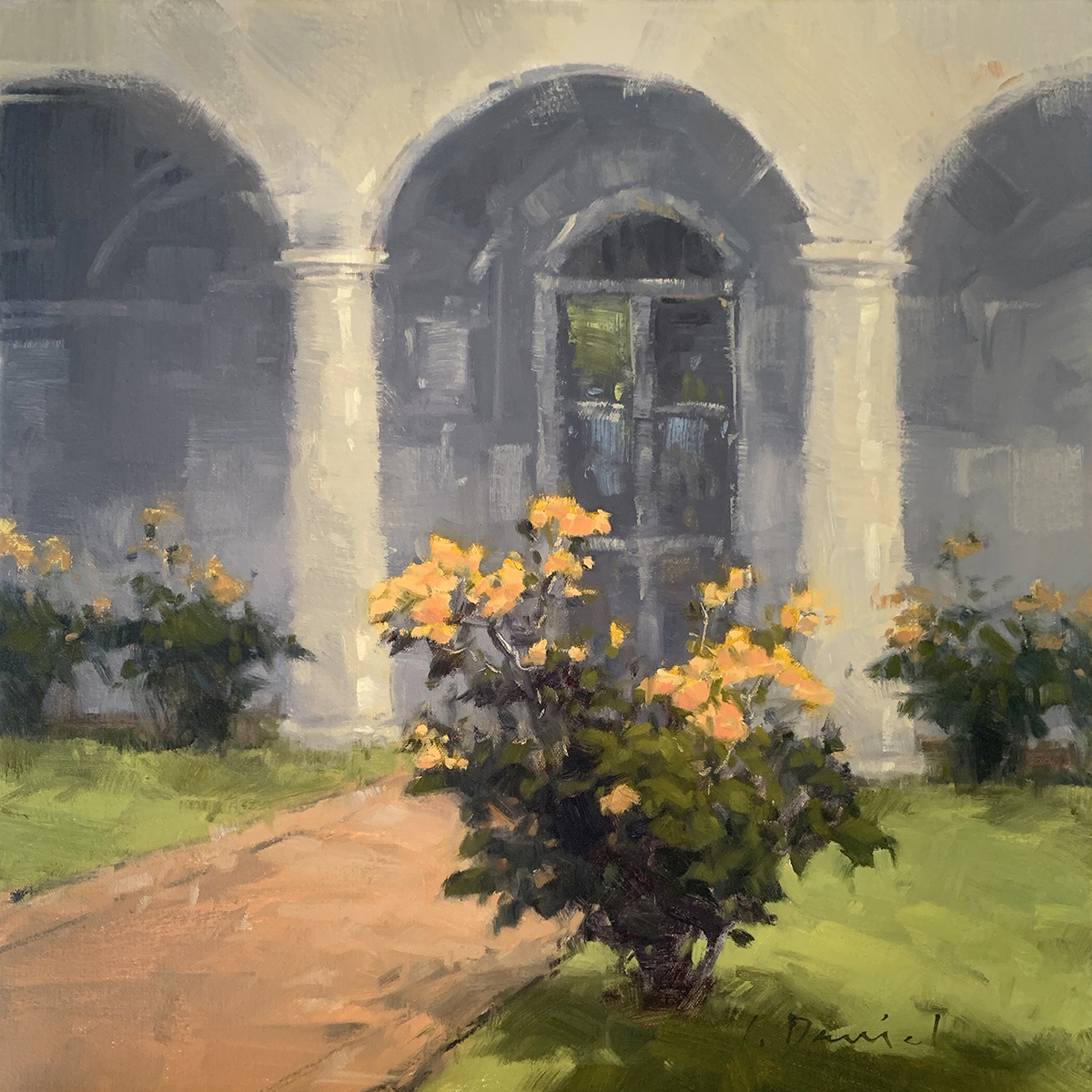
Courtyard Color

Courtyard Color, 8x6, oil on panel, L. Daniel © 2020
SOLD

I do love a garden courtyard! This is another piece from my plein air excursions in Georgia. After a picnic lunch in a shady spot and a bit of recon on Jekyll Island, we discovered that this courtyard was open AND empty! (Usually, lunch is being served under these porticos, but it was still shut down due to COVID.) There was even music playing! Truly Divine!

In these times of unrest, I share this moment of peace with you. May we all find pathways to healing, individually and as a nation.

Thursday, June 4, 2020

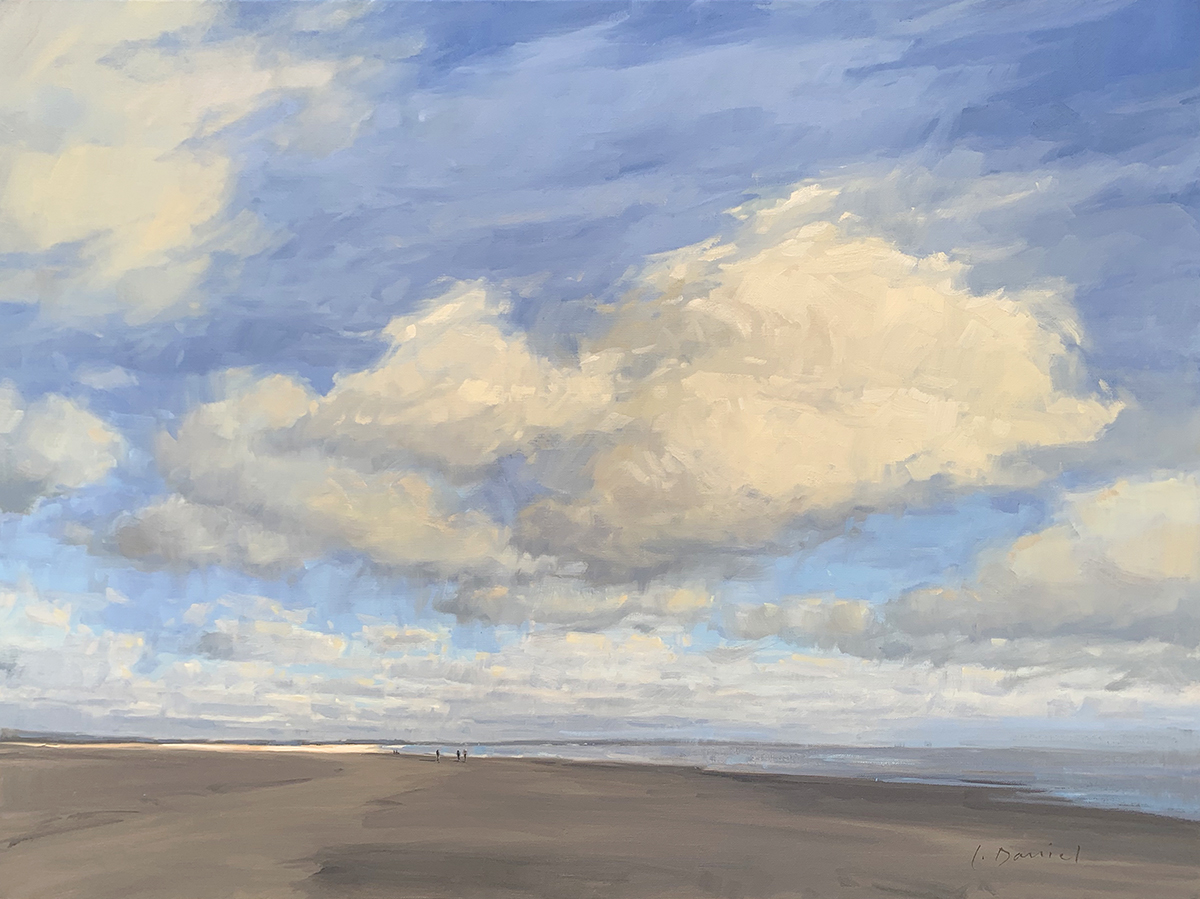
Distant Shore - Fix It Friday #14

Distant Shore, 30 x 40, oil on canvas, L. Daniel © 2020
SOLD

This was another large-scale "make-over" project... As I shared a few weeks ago, changes can can be scary, particularly when I have worked long and hard on a distinctly large piece. My fearful voice whispers, "leave well enough alone", while my bold voice cheers and cajoles, "don't be a wimp, go for it!!"

BEFORE

AFTER

CHANGES:
Problem 1 - The scene lacked the sense of depth I was going for.
Fix 1 - Enlarged the foreground clouds. This not only brought them closer (which helped push back the distant shore), it also provided the "reason" for such extensive beach shadows.
Fix 2 - Defined the distant figures to help reinforce the sense of scale.

Problem 2 - The sky lacked movement and drama.
Fix 1 - Gave the clouds more action by breaking up the edges.
Fix 2 - Added more layers of stratus clouds in the distance to enhance sense of movement.

OBSERVATIONS:
So what was I going for?? I wanted to capture that expansive, immenseness of nature's elements. I think I got a little closer in the second version, but it's a never ending pursuit. Creation is wonderfully grand.


Click Here to see Fix it Friday #11
Click Here to see Fix it Friday #12
Click Here to see Fix it Friday #13

Wednesday, June 3, 2020

Morning Reflections

Morning Reflections, 9 x 12, oil on panel, L. Daniel © 2020

Last week, I was able to get outside and do some plein air painting in Georgia. Things are beginning to open up there (with lots of caution of course), and it felt mighty good to be out and about. As I drove over to Jekyll Island for the day, this view on the causeway stopped me in my tracks. We had a lovely breeze, and a morning with drifting clouds and calling birds. DELISH!

I'm sure you share my longing for the day COVID is in our rearview... let it be soon!


Thursday, May 28, 2020

Azure Fields - Fix It Friday #13

Azure Fields, 24 x 36, oil on canvas, L. Daniel © 2020
SOLD - private collection

This is another Fix-It from my archives. Although the painting (and changes) are several years old, it illustrates a huge lesson about landscapes that I encounter again and again... 


BEFORE


AFTER

CHANGES:
Problem 1 -  The horizon line split the top of the painting from the bottom of the painting (I'm referring to the sharp edge and high contrast where ground plane met the upright plane. The ground plane looked like a skating rink, am I right?)
Fix 1 - Muted/darkened the color of the ground plane which eliminated the high contrast.
Fix 2 - Softened the static, hard edge with grasses and flowers that break the horizontal line.

OBSERVATIONS:
To establish depth in a painting, we have several devices in our toolbox: 1) overlapping layers (indicates front and back), 2) scale shift (elements get smaller as they recede), 3) muting color (color gets more dull and cooler as it recedes), 4) eliminating contrast (values weaken as they recede.) Eliminating that sharp line at the horizon allowed everything to settle in. Ahhh... what relief!!! :)

Thursday, May 21, 2020

Beach Cove Overlook - Fix It Friday #12

Beach Cove Overlook, 18 x 36, oil on canvas, L. Daniel © 2020
SOLD

Today, I am re-sharing a "fix" I made a few years ago... 
After enlarging a plein air piece I painted in California, I immediately saw problems that had not surfaced in the smaller study. Sometimes that happens when going from small to large. 

Here's what happened next...


BEFORE

AFTER

CHANGES:
Problem 1 - The main subject was unapproachable (grass and foliage in the way).
Fix 1 - Added a pathway that leads to the main subject and focal point. 

Problem 2 - The cove was too circular and dominant.
Fix 1 - Pushed it back by making the shape of cove and waves more elliptical.
Fix 2 - Increased the mass and height of grasses on the bluff to visually overlap the cove (which also helps to subdue it and push it back). 

OBSERVATIONS:
This had the classic battle of different elements fighting for the spotlight. Background was trying to come forward, and the subject was a bit buried. By clarifying a hierarchy of elements, the tension lifted and the whole scene was able to settle into place.

Click Here to see Fix it Friday #11

Thursday, May 14, 2020

Bait Shop Morning - Fix-It Friday #11


Bait Shop Morning, 8 x 16, oil on panel, L. Daniel © 2020
SOLD

This plein air painting has been sitting in my studio for a couple of years... just waiting for some attention. It depicts a long-standing bait shop out in the middle of a marsh in the Golden Isles of Georgia. I love the dancing trees along the road that leads to it, and I have painted it several times from various angles and in different lighting. When I painted this one on location, I just didn't quite "get" the light and ambience of the day...

So, years later, here are some fixes... 

BEFORE

AFTER

CHANGES
Problem 1 - The horizon line and row of trees was smack-dab in the middle of the picture plane and divides the painting into halves. 
Fix 1 - Dropped the horizon line, the base of bait shop, and the roots of the tree trunks.

Problem 2 - The light lacked commitment and its source was undefined.
Fix 1 - Added color to morning sky.
Fix 2 - Darkened cloud bank.
Fix 3 - Added highlights to bait shop and trees to indicate light source.
Fix 4 - Darkened foreground marsh to focus light on the subject (the bait shop and road).
Fix 5 - Darkened distance uprights to help highlights in subject to pop.

OBSERVATIONS:
When painting the landscape, it's important to leave some of the details out. That can be hard because there is so much going on, and everything seems important. But we have to choose what is MOST important. It helps to keep asking myself, "what is the painting about?" I always do better when I stay "on message".

Notice everything, and then choose.